Thursday, November 22, 2007

The President's Pad

Tuesday afternoon President Wong's wife took C***o, R****i, and me to Zhuhai to show us their apartment in the college-owned complex. Their unit is on the top floor of the building across from the one we'd visited last weekend. We took an elevator up to the eleventh floor — the first elevator I've been seen in a residential building in China (even ones as tall as seven stories, like the one I live in on campus, have only stairs), but I suppose that as modern high-rises become as common as they are in Zhuhai, they're likely to become standard.

The Wongs’apartment has two floors — another rarity for China — with two bedrooms on the lower floor and three upstairs.


Also unusual are the large windows that flood the living room with light, and the chandelier.


The apartment boasts many modern conveniences, like a projection TV with a large screen that lowers from the ceiling.

The eleventh-floor balcony affords a sweeping view, but unfortunately it encompasses nothing but the other high-rise residential buildings that have gone up in the past few years or are under construction.

After touring the apartment, we headed off for foot massages (which seem to be the favorite affordable luxury among many Chinese people) and then an early dinner (C***o had to be back in time for a 7:00 class) at a hot pot restaurant.

Hot pot, for those who don't know, is a style of dining that originated in the north where thinly sliced meats, noodles, vegetables, and other ingredients are cooked at the table in pots of boiling, seasoned broth. I prefer to have hot pot in the winter — it's a great way to warm up on a cold day — but it's popular here year-round.

The restaurant we went to — located in the Jida district behind the Jusco department store I've been to several times — had a feature I've never seen before: a table with condiments to add to the sauce that you dip the cooked items into.

Beef and lamb are the standard meats used in hot pot. They were accompanied by four or five different types of greens . . .

. . . and several varieties of noodles.


Restaurants in China always have individual pots for each diner; in America, for some reason, there's always a single large communal one that everyone dumps their items into, which strikes me as a far inferior system. Although all the restaurants I've previously been to in China brought out butane burners for each pot, here there were electric burners built right into the table.

Back home Ling and I have often served hot pot as a holiday dinner — it's graced our table at Christmas more than once — but this meal came a couple of days too early for me to think of it as a Thanksiving stand-in. It would have seemed an inappropriate substitute anyway: Cooking a small tidbit of beef in less than a minute strikes me as the antithesis of roasting a turkey for hours.

Wednesday, November 21, 2007

Thanksgiving Dinner

As Hilary consoled me, duck is just as good as turkey — maybe better. But unfortunately, it doesn't come with cornbread stuffing or cranberries.

Tuesday, November 20, 2007

DVD Delights

Although I hadn't been planning to buy any DVDs when I went to Gongbei on Monday, I decided to drop in on a shop that had the largest and most varied selection that I had seen anywhere in Zhuhai. I didn't spend much time there when I first stumbled upon it, mostly because their labeled price was 30 yuan per disc, twice the standard elsewhere; even if you take that as a starting point for bargaining, it wasn't a good sign. But as soon as I commented on the high price the clerk offered to halve it, and when I said I'd buy at least ten if he'd cut the price to 12 yuan — about $1.60 — he agreed (after checking with a manager, a move that might have been just for show).

I selected three vintage Chow Yun-Fat movies, plus The Myth, a 2005 Jackie Chan Chinese film; Ling and I saw a little bit of it on a TV in a department store the last time we were in China, and it looked watchable — certainly better than any of his American efforts.

I was surprised to see these obscure arthouse titles for sale in China: The top two are compilations of early American avante-garde cinema; The Pervert's Guide is an idiosyncratic bit of film criticism that I missed when it played the Film Center a few months ago; and Come and See is an acclaimed Soviet WWII saga from the 1980s.

The classics: Godard's Breathless, Schlesinger's Billy Liar, René Clair's Under the Roofs of Paris, and a Keaton hodgepodge of obscure shorts, commercials and TV appearances, and other miscellany.

Leaving with my haul of rarefied cinematic works, I headed for the back alley shop where I'd previously bought a few Hollywood pics of more recent vintage for a third of the price of the mall stores. This time I bargained the price down to 4 yuan, just over 50 cents — the cheapest I've ever bought DVDs in China (or, I suppose, anyplace else). I couldn't resist the chance to pick up a few titles that had come out since I left Chicago, to cut down on what I'll have to catch up on upon my return (although actually, none of them are likely to have made my must-see list). Brian De Palma's Redacted had only been in theatres for three days when I bought it; sometimes these newer-than-new bootlegs are made with a camcorder held in front of the screen at a preview, but in this case it was duped from a studio screener — the ID code ocassionally surfaced at the bottom. And I bought the cheaply packaged set of the first five seasons of Scrubs largely to satisfy my curiousity about how they squeezed 100+ episodes on just five discs.

The Gongbei Routine

I'm a bit behind in my blogging, due largely to the fact that the pleasant weather has been enticing me to spend as much time outdoors as possible — especially after hearing the forecast of holiday snow for Chicago. And my plans to catch up tonight were nearly derailed by a fortuitous encounter earlier this eveing that led to a dinner with much pijiu and gambeiing (which I'll report on in a future posting). But I'll try to overcome my slight inebriation to forge ahead with my posting plans.

On Monday I made my usual weekly shopping trip to Zhuhai city. There wasn't anything that I particularly needed to buy, but after languishing on campus all day Sunday, I just wanted the change of scene. I must have made the trip between the college and Zhuhai a dozen times by now, but I still haven't tired of looking out the window at the countryside, the people, the shops, and even the crazy traffic.

After alighting from the bus, I strolled through that stretch of restaurants with the lively outdoor dining scene that had so impressed me one night last week. But as I expected, the stretch was pretty dull during daylight, even at lunchtime.

This sidewalk dishwasher gives you an idea of the sanitation standards here.

I ducked into a building that turned out to contain one of those vast indoor food markets that had impressed me, first in San Zao and then in Jida. Besides the merchants selling the same sort of produce that you commonly see at the outdoor markets, these enclosed ones also sell meat . . .

. . . and fish. And as you can see, refrigeration doesn't enter into the picture at all. But what I'm now finding more interesting than the lack of refrigeration is my level of acceptance of it. On my first visit to China, some ten years ago, I found such practices shocking. Six weeks ago, when I arrived for my teaching stint here, I suppose I would have made note of it. But now I barely even shrug. Perhaps it's my awareness that my the ingredients of my dinner that night will likely have been treated in such a fashion; it's either accept or starve.

When the food's been cooked, like these roast birds and other meats, the lack of refrigeration's a bit easier to accept. Even so, I decided to head for the undergrund Port Plaza mall for my favorite restaurant with the English-language menu.

After a tasty chicken curry, I headed upstairs and outside to the less genteel market area where the genuine bargains are to be found. I hadn't been planning to shop for DVDs that day — I'd figured I'd stock up before returing to Chicago — but I wound up finding some surprising titles that I just couldn't resist; I'll detail them in my next post.

Lugging my sackful of DVDs, I headed for the bus stop by way of the side streets and back alleys that I found so enticing the first time I encountered Gongbei. But again, I strode right by sights that would have had me pulling out my camera a month ago. Even the incredibly brazen streetwalkers (my online research has confirmed my assumption that the district is a hotbed — pun intended — of prostitution) didn't faze me. I'm not jaded — I still love taking in the scene — but at this point I guess I can state that I longer feel like a gawking tousist.

Sunday, November 18, 2007

21st- and 19th-Century Zhuhai

On Saturday, I tagged along again as one of C***o's coleagues took her to Zhuhai city to see the apartment buildings the college owns there. Apparently once you've worked at the college for a certain number of years, you can get a unit in the buildings; many faculty have both a residence on campus and one in the city (which explains how they can stand living in a region as desolate as the one surrounding the campus — they don't, at least not all the time).

The buildings are very modern — they went up within the last two years — and look essentially like the hundreds of others that are sprouting up around the city, especially on its outskirts. (These are in a similarly undeveloped part of town; other than dozens of other apartment buildings of similar vintage, the nearby area is largely barren, with hardly any retail stores or much of anything else)

We got a tour of the interior of one of the units, which are somewhat larger than the standard Chinese apartment, but with the same ubitquitous white walls and white vinyl tile on the floors. The landscaping is nicer-than-average as well, and there's even underground parking. President Wong lives in the building across from the one we visited.

Other new construction going up nearby dwarfs the older dwellings that probably aren't long for this world.


We then joined about a half-dozen other people, some of whom I think lived in the complex, for a tour of nearby attractions. As usual, no introductions were made (or, more precisely, half-introductions were made: C***o told the newcomers, in Mandarin, who I was, but never said anything to me about them), but I learned later that the three men all worked for Zhuhai's propaganda office, which meant that they promoted tourism to the city (I told C***o that the proper English word was "marketing" — "propaganda" connoted political objectives — but she insisted that was their actual title.

Our first stop was the stone archways located at the site of a village called Meixi, built by the emperor in the late 1800s to honor Chen Fang, the first Chinese consul to Hawaii. There were originally three archways, but one was destroyed by the Red Guards during the Cultural Revolution.

The grounds also include the residences Chen built for himself and his sons in the 1890s after he returned from Hawaii, where he'd started several businesses, served in the legislature, and married a princess.

The outdoor dancing room in Chen's residence combines Romanesque arches with Chinese ornamentation.

One of the buildings contained a wax museum depicting notables who hailed from Zhuhai. All eras were covered, from these early nobles to Communist Party leaders to China's first world table tennis champion.

More interesting was a small museum featuring a collection of 65 plaques from Chinese businesses and homes. The exhibit combined calligraphy and culture, although it obviously would have been more meaningful if I could have recognized what the plaques said.

Next on the itinerary was the nearby Agricultural Research Center, also known as the Agronomic Wonders Land (or, as the sign says, "Agricultural Paradise"). Unfortunately, we arrived there at dusk, too late to do anything other than take a quick look at a few of the many greenhouses on the grounds.

By then it was dinnertime, so we drove to a nearby restaurant. Our private dining room (where the waitress is icing a bottle of red wine — but it's Chinese wine, so that can only help) included the standard television set for post-dining karaoke . . .

. . . but also a ping pong table, an accoutrement I'd not seen before.


The dinner was another consistently scrumptious banquet, with one knockout dish followed by another, and then another — it’s kinda scary how blasé I've gotten about the meals here, and I know I'll look back at that placid acceptance in disbelief when I'm back home in a few weeks. I'll constrain myself and only post a few shots of dishes I hadn't had before:

These savory little pigeons weren't an alternative to duck . . .

. . . because that came later, albeit in a casserole rather than roast.

These pancakes were eggier than typical.

Okay, these clams aren't new — but don't they look great?

Near the end came these pan-fried items made of a Japanese-like glutenous rice flour, but with some sort of cruncy vegitable that varied the texture interestingly.

The meal was obviously wonderful, but what made the evening stand out was the liveliness of the group, spearheaded by the three propaganda officials. The one in the middle is apparently their boss, judging from the way they deferred to him. The guy on the right had a rollicking sense of humor that I enjoyed even if I couldn't understand his jokes.

The rest of us (including, here, C***o, R****i, C***o's colleague, and the younger propagandist's wife) largely sat back and participated in the many toasts. As often happens when I'm a guest at one of these banquets, the men all wanted to share one-on-one toasts with me, so I drunk more than my share that night; once again, I impressed them with my capacity, and they loudly voiced their approval every tim I drained my glass. And I learned a new flourish from the jovial pudgy fellow: At the end of each gambei, I'd invert my glass to accentuate its emptiness.
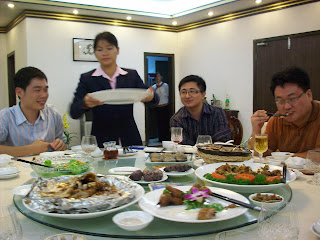
I don't think I've mentioned that at these banquets there's always a waitress standing by — and often two — to refill glasses, replace dirty plates, and attend to any other needs. It's a level of service that's obviously lacking in the States, and I especailly miss it at Chinese restaurants there — it's just not the same when you have to pour your own tea.

The head propagandist turned out to be a remarkably talented singer, who entertained us with everything from traditional Chinese songs to Italian arias. He was so good that the rest of us were too intimidated for karaoke (which to me was just an added benefit of his performance).

Considering the vast quantities of pijiu I'd ingested (as well as just a bit of liquor), I was in pretty fair shape when I arrived home. But just the same, I was glad that I didn't have class — or much of anything else I had to do — the next day.

Friday, November 16, 2007

Spouting Off on Sports

Thursday afternoon I gave the latest in my weekly series of lectures on American culture, this one on sports in the U.S. (delayed, ironically, by the campuswide sports event held last week). While I don't consider myself much of a sports fan (and many of you will call that assessment a vast understatement), as I told the students, sports are so pervasive in America that you can't live there for as long as I have without absorbing enough knowledge to talk on the subject for an hour or so. Even so, I was tempted to take Aaron's joking advice (based, I assume, on his current gig teaching Entertainment Journalism at Columbia College) to just make stuff up during my lectures, since who'd be the wiser? However, some of these kids follow the NBA avidly enough that I'd suspect they could call me on any fraudulent info on that sport.

However, the entire group of several hundred students possessed near-total ignorance of baseball or American football (just football, of course, refers to what we'd call soccer), although they feigned interest in my explication. Basketball is another matter: My previous visits to China had already revealed the high level of interest in the sport (when the Bulls were playing in the championships, the games seemed to be followed here nearly as closely as back home). I was a bit surprised, though, that while many of the kids — and not just the boys — watch NBA games, they play little attention to the Chinese Basketball Association. My queries revealed that the Americans’far superior level of play trumps nationalism.

The lecture seemed to be as well received as my previous ones, and I think that I managed to handle the questions fairly well; I even adequately fielded one on World Wrestling Entertainment (which I still think of as the WWF).

Afterwards, Mr. Wong — the president of the college and Ling's longtime friend — took me to dinner, along with two other foreign-language teachers: Hyoung Su (a.k.a. Leo), the Korean instructor whom I've shared a couple of meals with already, and Ken, the other American currently on campus. The faculty have been trying to get Ken and me together ever since I got here, but our schedules hadn't meshed till now. He's a Tourism Management teacher at the University of Nevada Las Vegas, which has a reciprocal arrangenemnt with the same department here (one of my own classes is under the Tourism department; obviously, English would be a valuable skill for anyone taking Chinese people to the U.S. or vice versa). Ken's only here for six weeks, and he's going back Monday; his imminent departure was apparently the occasion for the dinner.

Unfortunately, I didn't manage to get a very good pic of Ken; in this dim one he's between Wong (who was, obviously, seated next to me) and one of the college's vice-presidents (I didn't get his name or exact title; introductions here are often abrupt or even nonexistant, which is why business cards are so useful).

It's been a while since I've photoblogged individual dishes, so here's a selection of what Wong ordered. This was the first time I'd seen chicken feet other than as a dim sum item.

One of the best ducks I've had so far this trip, obviously surpassing the version I've been enjoying regularly in the campus dining hall.

I don't think I've been to a banquet here that hasn't included shrimp — but that's fine with me.

I think this delicately spiced fish soup, served in a coconut shell, was the best soup I've had here.

Two more regional standbys: whole steamed fish . . .

. . . and sea snails.

The picture's a bit dark-looking, but so was the dish: Pork cooked with black tea leaves.

Pastries for desert. Unfortunaely, I was still enjoying the other dishes when this plate was brought out, so I missed out on the custard tarts, always one of my favorite ways to end a meal. But I did manage to take full advantage of the plate of watermelon, papaya, and other fruits that came later (not pictured because I was too busy chowing down to shoot it before my fellow diners did damage to it).

This evening featured even more toasts than usual, many of them to mark Ken's leaving. We were drinking strong Chinese liquor (which I don't enjoy much normally — I'm a wine and beer guy — but the bottle we had here was top-shelf stuff, and even I could appreciate the difference) before we switched to pijiu later. At banquets, tablewide toasts are supplemented by ones between just two individuals: Wong and I drank a toast to Ling, and then another one to C***o. I drink enough without getting more than slightly tipsy that I now feel up to a real challenge: Hyoung Su and I are planning to go out drinking together next weekend.

Return to the South Gate Restaurant

Ever since the English Club took me to that restaurant outside the campus's South Gate, I've been wanting to take C***o and R****i there, and we finally made it there tonight. C***o ordered, with some suggestions from me based on my prior visit, and I paid the minimal check. I had guessed that the place serves mostly Northeastern food, and I was right; it turns out the owner is from Changchaun, Ling and C***o's home town.

C***o ordered so much that we took home leftovers — that doesn't seem to happen much here (the uneaten food usually just goes to waste). We had the sauteed shredded potatoes that are popular in the Northeast, as well as a lamb and scallions dish, chicken and mushrooms, and the pork moo shoo that I had enjoyed so much with the English Club. After C***o and I drank about half of the bottle of wine I bought her in Hong Kong a week ago (Rongli doesn't care much for western wine), we also polished off a couple of large (one pint) Tsingtaos. The bill came to 78 yuan — just over $10. Back home, the beers alone would cost more than that. And,of course, dining outdoors in mid-Novmeber is a treat in itself. Is it any wonder that I'm already beginning to get glum about my departure in a couple of weeks?